Understanding ALICE, Part 4 of 4. October is Understanding ALICE Month at the United Way of Lee County. All month, Opelika Daily News is digging into the numbers behind the households that work but still can’t cover the basics.
ALICE households are found in every part of Lee County and in every demographic group. But some neighbors are far more likely than others to be working and still short.

Single parents carry the heaviest load
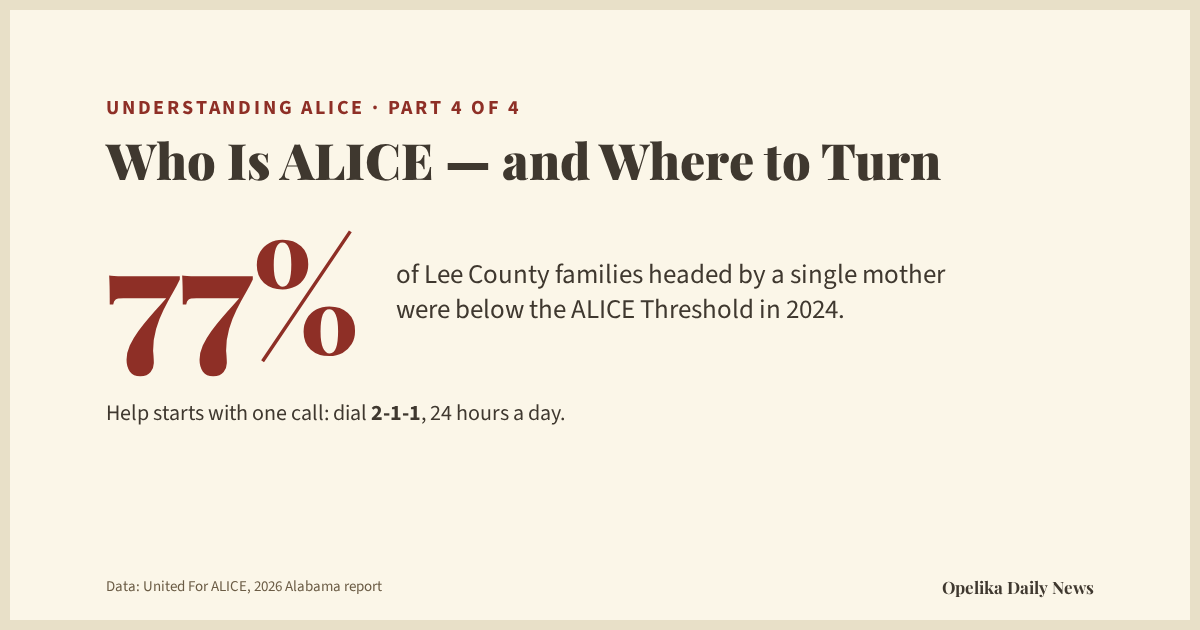
In Lee County, 77% of families headed by a single mother and 51% headed by a single father were below the ALICE Threshold in 2024. For married couples with children, the share was 17%. Single and cohabiting adults without children, the most common household type, were at 46%. The statewide figures are similar: 80% for single mothers, 58% for single fathers and 18% for married parents.
Young and old
Lee County’s youngest households have the highest rate. Seventy-nine percent of households headed by someone under 25 were below the threshold, but that number is driven by Auburn University students living off campus. Students are counted when they live on their own and aren’t counted in dorms.
The more telling number may be at the other end. In Lee County, 40% of the 16,922 households headed by someone 65 or older were below the threshold. That is better than the state’s 52%, but it still adds up to about 6,700 senior households. Statewide, households headed by people 65 and over were the fastest-growing age group from 2010 to 2024, up 43%. A single senior in Lee County needs $34,788 a year to cover the basics, more than a working-age single adult, mostly because of higher health care costs.
Race and place
In Lee County, 63% of Black households, 56% of Hispanic households and 37% of white households were below the ALICE Threshold in 2024. White households were the largest group by number: about 18,250, compared with about 9,570 Black households. Statewide, the report ties the gaps to longstanding barriers in work, housing, education and access to community resources. It also found more hardship in rural counties (50%) than urban ones (43%).
Where to turn
For anyone who is short on rent, utilities, food or child care this month, the simplest first step is 2-1-1.
- Dial 2-1-1 (or 888-421-1266), or text your ZIP code to 898-211. Lee County’s 2-1-1 line, run with the United Way, is answered by a real person 24 hours a day and connects callers to local help.
- United Way of Lee County Community Fund helps with power or gas bills during extreme financial hardship. It is mostly for elderly and disabled residents and is available once a year.
- United Way Last Resort Fund, run with Publix, provides short-term help for employed people who can document a recent, unexpected hardship. That is ALICE by definition.
- Community Market (food assistance): 334-749-8844
- East Alabama Services for the Elderly (EASE): 334-826-5811
- Early Connections (support for families with young children): 334-742-2112
- Auburn Community Development Food Pantry: 334-821-2262
Wondering where your own household stands? The ALICE Budget and Income Status Tool lets you enter your county, household size and income.
What would help
The report doesn’t make specific policy recommendations, but it lists areas where different groups can act. Employers can look at wages, schedules and benefits that help keep ALICE workers. Nonprofits and local governments can use the data to target programs. Policymakers can study “benefits cliffs,” where a small raise can cost a family more in lost aid than it gains in pay. The report also notes that roughly 20% of eligible taxpayers nationally don’t claim the federal Earned Income Tax Credit. Free tax-prep programs and outreach can help close that gap.
Neighbors can help too. The United Way of Lee County’s campaign is trying to raise $750,000 this year for its 29 community partners. Learn more at unitedwayofleecounty.com/alice.
“Learning about ALICE may be the first step, but we hope it doesn’t have to be the last,” Miller told the Opelika-Auburn News.
Check the ALICE numbers where you live
United For ALICE publishes the data for every state, county and city. To look up your own community, open the Alabama county reports, pick your county, then scroll to “Additional Geographies” to find your city, town or ZIP code. To compare any state, use the national ALICE map and choose a state from the menu.
The Understanding ALICE series
- Part 1: Working, but Not Getting By: 4 in 10 Lee County Households Fall Below the ALICE Line
- Part 2: What It Costs Just to Get By in Lee County: $84,504 for a Family of Four
- Part 3: On the Clock and Still Short: The Jobs Behind Lee County’s ALICE Numbers
- Part 4: Who Is ALICE in Lee County — and Where to Turn for Help (you are here)
Data: United For ALICE, 2026 State of ALICE in Alabama report and Lee County profile (2024 data), produced with United Ways of Alabama; U.S. Census Bureau American Community Survey. Written with AI assistance and reviewed by Opelika Daily News.